In Galveston’s East End, where Victorian homes whisper stories of storms weathered and decades endured, Natalie Brooks found a property that spoke to her. The ER nurse practitioner and interior designer doesn’t just renovate historic homes - she listens to them.
“I just sort of go sit in a space for a while,” Brooks says. “This may make me sound a little crazy, but I let it talk to me. It tells you what it wants to be when it grows up, and I just embrace that and run with it.”
That philosophy guided her recent transformation of the 1903 bungalow at 1003 Sealy - along with its rear apartment - originally built for Charles and Mary Drouet. (Charles’s father, Sebastian, served on the steamship Bayou City during the Civil War’s Battle of Galveston.)
What Brooks accomplished in just two and a half months is remarkable: two complete kitchen renovations, three bathroom overhauls, a full interior repaint, new HVAC, complete re-piping of both structures, and furnishings that make guests of the short-term rental never want to leave.
A Childhood Calling
Brooks’ passion for historic preservation began far from Galveston, in the abandoned farmhouses scattered across the fields of southern Missouri. As a child, she was irresistibly drawn to these forgotten structures, slipping inside whenever she could, captivated by something she didn’t yet have the words for.
“I remember as a little bitty kid, much to my mother’s dismay, I would go into these old houses and just kind of want to be in those spaces,” she recalls.
“I just feel like there’s something so grounding and centering and calming about knowing that a certain spot on a banister has been touched for the last however many years by so many other hands.”
She laughs remembering her mother’s reaction - a mix of worry and exasperation - punctuated by pleas of, “Could you not go to the second floor in those places and end up as a trauma alert in an ER?”
 The irony isn’t lost on her. Brooks would eventually spend her career in an ER setting, though she now approaches aging buildings with far more expertise - and considerably better safety precautions.
The Tale of Two Professions
By day, Brooks navigates the controlled chaos of emergency medicine. At night and on weekends, she shifts into her second life as the owner of Intuitive Interiors, the design firm she built around restoring historic properties.
She calls it “a very bipolar professional existence,” but one that satisfies both the analytical and creative sides of her brain.
“The medical side of my brain is fast-paced,” she says. “It’s critical thinking, and it’s controlled chaos all the time - and sometimes uncontrolled chaos.”
Then she laughs. “And I can step away from that and sit down to sketch a new space or start sourcing unique pieces. It decompresses one side and feeds the other.”
Those critical-thinking skills serve her well on job sites, too. When a contractor in Florida pushed back on her plan to install salvaged 1920s French doors - complete with a spider-web glass transom - into a load bearing wall, Brooks didn’t budge.
“I told him we had twelve-foot ceilings to work with, that we were going to get a jack, and it would be fine.” He eventually conceded that the plan was structurally sound.
The doors went in, and today they’re one of her favorite features in that home.
The Galveston Project
Brooks bought the Galveston bungalow last August - her first property on the island, though far from her first renovation. With her oldest grandson living in the East End, she had been visiting at least once a month for five years, falling a little more in love with the historic neighborhood each time. Every walk or drive revealed another house quietly calling her name.
The cottage on Sealy was in generally good condition when she purchased it. “It was kept up, but it was tired,” she says. Brooks, however, saw past the dated cabinetry and worn finishes to the soul of the place.
“I work a lot, so I have a great team of people who do the things that require talented craftsmen,” she explains. “I’m the idea girl, and then I come in and do the finesse at the end.”
She spent about a week on the island, working sixteen to twenty hours a day to nail every detail. She installed new cabinetry in both kitchens, replaced nearly every light fixture - keeping only the original in the main house’s living room - refinished the floors, updated showers, added a clawfoot tub, and created custom window seats that look original to the home.
In reality, they began as clearance benches she found on Wayfair.
“I wanted storage underneath because storage is such a premium in those old houses,” she says. After painting the benches to match her custom cabinetry, her installer trimmed them out “so it looked like it was all built in and part of the original process.”
Past Respected, Future Reimagined
For Brooks, successful historic renovation begins with honoring what came before while thoughtfully introducing what modern living requires. “If you don’t respect these properties and what they are - if you try to make them something they’re not - you’re not really doing the place a service,” she says.
The challenge, as she sees it, is “bringing in the things you need for modern comfort and modern living while still not tainting anything that history gave you within that property.”
She drew her design direction from the home’s exterior palette, carrying its greens and shamrock tones throughout both structures. “It was just such a lovely color - natural and healing - so I tried to lean into that.”
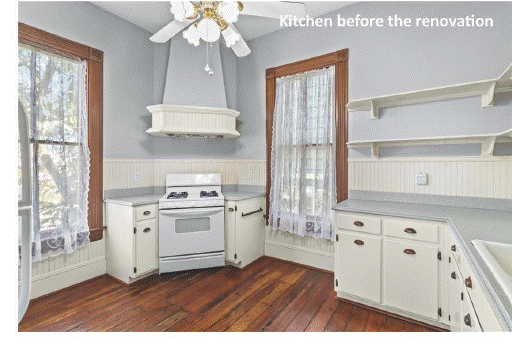
The main house kitchen quickly became her favorite space. Once lacking an island, window seats, or much personality, it now radiates warmth and functionality while still honoring its historic character. A former owner had cleverly repurposed the original pantry to include a laundry area - a detail Brooks appreciated and preserved.
The house also came with a photograph of Charles and Mary Drouet, which Brooks hung in a prominent spot in the dining room as a nod to the home’s earliest chapter.
And tucked away in the attic, she discovered a small montage of photographs - likely from the 1950s or ’60s - showing the house during an earlier restoration, “completely falling apart, with exposed shiplap and all of the things on the inside.”
It was a reminder that every generation leaves its mark, and hers is simply the latest steward of a long, resilient story.
The Philosophy of Home
 No matter the price point or the scale of the project, Brooks’ design philosophy stays the same. “Even in the highest-end houses with no budgets,” she says, “you still want to be able to put your feet up and be comfortable and happy in the space. If it doesn’t feel like a hug - even with the finest finishes - you’re not doing it right.”
The Galveston bungalow, now a thriving short-term rental, has already earned glowing reviews that prove her approach works.
“My favorite reviews are always from people who say it felt like home, that they never wanted to leave,” she says. “Those just make my whole heart happy.”
Looking Forward
Brooks plans to move to Galveston full-time within the next year and a half, and she’s already imagining her next project. “I want my primary residence to be on the island,” she says.
“I want to bring something back from the ashes - something that might look like an eyesore now but has a soul and beautiful bones that I can restore and make a meaningful part of the island again.”
In two years, she’ll step away from medicine entirely to focus on design, continuing her mission of rescuing historic properties and letting them tell her their stories.
For now, Shamrock on the Shore stands as proof of what happens when skill, intuition, and respect for history come together - a space that, in Brooks’ words, “has a life all its own. It’s wonderful.”