It’s possible to drive past it a dozen times without ever knowing it’s there. And that, in many ways, was exactly what its founders intended.
Cedar Lawn Historic District - Galveston’s first fully planned residential community - turns one hundred this year and remains as deliberately secluded from the rest of the island as it was the day its first resident moved in.
Tucked between 45th and 48th Streets and Avenues L and N, just two miles west of Galveston’s central business district, Cedar Lawn occupies nine square blocks of quiet splendor. Its curved, butterfly-shaped street pattern was designed so that every home faces inward toward the shaded lawns.
Towering trees deepen the sense of calm and privacy, as do the absence of street and traffic signs and the wide, fenceless lawns uninterrupted by sidewalks.
In June 1926, the Cedar Lawn Company purchased nine square blocks in the northwestern section of the Denver Resurvey for $38,000. Its three officers - William Lewis Moody III (president), William Douglas Haden (vice president), and Clark Wallace Thompson (secretary and treasurer) - shared more than a business venture. Moody and Thompson were brothers-in-law, and Haden was Moody’s father-in-law.
The neighborhood was conceived as an enclave for the Moody family, executives of their far-reaching commercial enterprises, and close friends - an opportunity for residents to choose their own neighbors.
The men also recognized that the rise of the automobile was reshaping where Galvestonians could live relative to where they worked, making a location west of downtown both practical and desirable. Soil from the mainland was spread across the development, and Bermuda grass was planted to enhance its oasis like appeal.
By 1927, lots in Cedar Lawn were being advertised in local newspapers at $2,250 for a sixty-foot parcel.
The founders also had the foresight to establish deed restrictions to protect Cedar Lawn’s appearance, prestige, and architectural character for generations. One of the neighborhood’s most unusual features is that the residents own the streets themselves.
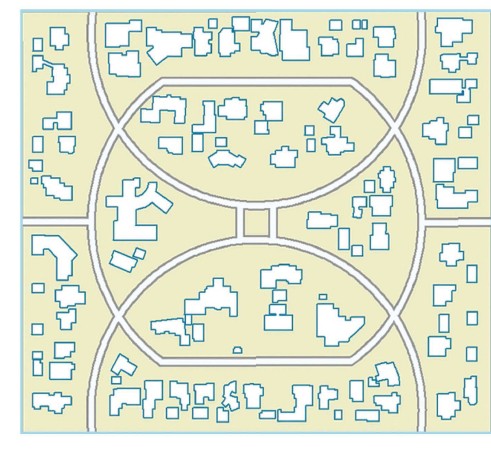 Today, there is only one public entrance, located on 45th Street. The other original entry points were gated and closed to through-traffic in 1997, though they remain accessible to residents in the event of flooding.
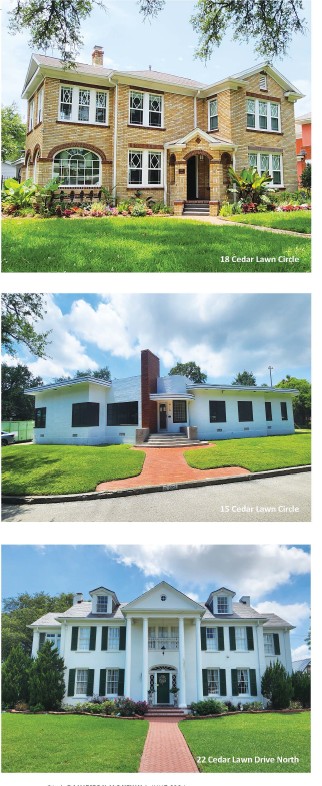
The first two houses built in Cedar Lawn set the tone for the neighborhood. Positioned directly across from one another on either side of the central garden circle, the W. L. Moody III mansion at 16 Cedar Lawn South and the Clark W. Thompson home at 15 Cedar Lawn North announced that this would be a neighborhood unlike any other on the island.
Occupying eight lots, the Moody residence - a stately neo-classical Georgian home designed by Robert Smallwood, residential designer for Alfred C. Finn - was begun in 1927 and completed in 1929.
After the main house was finished, Smallwood returned to design an impressive entertainment complex: a metal-framed glass bathhouse and greenhouse, a swimming pool, and a two-story servants’ house whose basement served as a power house and boiler room.
Though its glass walls and roof are gone, the pool enclosure still stands as a reminder of the grandeur envisioned by its designer.
The home of Clark and Libbie Moody Thompson (Libbie being the sister of W. L. Moody III) was designed by Donald N. McKenzie with an Arts and Crafts butterfly floorplan. It is said the homes were intentionally designed so the siblings’ front doors would face each other.
The large oak still standing in the front yard was planted by Libbie Moody Thompson’s parents and is known today as the Moody Oak. In the late 1940s or early 1950s, an addition provided the home with a downstairs sunroom, an upstairs dressing room, and an expanded kitchen.
What gives Cedar Lawn its visual appeal is the remarkable mix of beautifully maintained architectural styles, from smaller speculator-built houses to grand, commissioned mansions. Revival-style architecture dominates the pre-World War II homes, with Tudor Revival defining much of what rose through the 1930s.
Spanish Eclectic, Italian Renaissance, French Eclectic, Mission, and Prairie-influenced designs share the shaded streets with Dutch Colonial, Georgian, Neoclassical, Craftsman Bungalow, and Ranch-style houses. The postwar years added Moderne and Contemporary homes to the mix, creating a neighborhood that reads like a curated architectural timeline.
The architects who shaped Cedar Lawn’s appearance were among the region’s most accomplished. Cameron Douglas Fairchild - who also designed the Jesse H. Jones Library at the Texas Medical Center - contributed the Norman cottage at 24 Cedar Lawn.
Raymond R. Rapp left his mark at 11 Cedar Lawn North; his portfolio included the Congregation Beth Jacob Synagogue, the Hollywood Dinner Club, and the Balinese Room. Charles L. Zweiner, a key figure in restoring many of Galveston’s architectural jewels, including the Garten Verein, designed the Colonial Revival home at 40 Cedar Lawn South.
Alfred C. Finn, commissioned for the Moody residence, is also remembered for his work on the 1929 Scottish Rite Cathedral and the United States Post Office and Custom House on 25th Street.
Twenty-seven homes were built in Cedar Lawn’s first four years, with eleven more completed between 1930 and 1941 despite the challenges of the Great Depression. Construction paused during World War II, then resumed in the late 1940s, with twenty-four additional homes completed between 1940 and 1966.
Over its century, the enclave has been home to a U.S. Representative, two mayors, three judges, three Texas state representatives, and generations of doctors, business owners, and civic leaders.
Clark W. Thompson - who served as treasurer of American National Insurance Company and represented Texas in the U.S. House of Representatives for 22 years - built his home at 15 Cedar Lawn North. Silas Ragsdale, editor-in-chief and publisher of the Galveston Daily News, built his residence at 20 Cedar Lawn Circle.
The home now owned by Mike and Weez Doherty at 77 Cedar Lawn carries a remarkable backstory. The two-story, eight-room house with a central-hall plan was built in 1931 for Homer Thompson and his wife, Lucy Magill Candler Thompson, at a cost of $10,000.
Lucy’s grandfather, Asa Griggs Candler Sr., purchased the recipe for Coca-Cola for $2,300 and founded the company in 1892. Homer Thompson came to Galveston to open a branch of the Coca Cola Bottling Works and later served as a national representative for the brand.
The couple left for Atlanta in 1932, shortly after completing the brick home. Homer’s Spanish-style bottling plant at 53rd Street and Broadway, designed by Ben Milam, was recently razed.
 The Dohertys have lived in the home for 48 years. “When we first moved in,” Mike recalls, “many of our neighbors were original Cedar Lawn residents.”
The idea of choosing one’s neighbors didn’t fade during Cedar Lawn’s early decades. A 1948 advertisement for the few remaining lots urged buyers to “Buy them all and use them or pick your neighbors if you sell.”
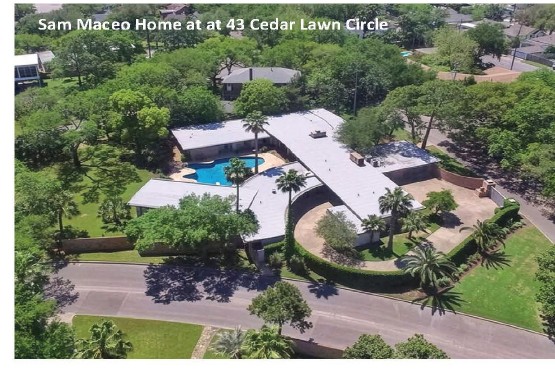
A colorful chapter in Cedar Lawn’s social history began in the late 1940s, when legendary Galveston entrepreneur Sam Maceo and his wife, Edna, decided to build a home for their growing family at 43 Cedar Lawn Circle.
At the recommendation of Maceo’s friend Frank Sinatra, the couple commissioned the Palm Springs architectural firm of Williams, Williams & Williams to design a sprawling, one-story, flat-roofed U-shaped residence centered on a courtyard with a swimming pool, a projection room, and a wet bar.
Sam Maceo died before the house was completed, but Edna and their children lived there for three years before relocating to New Orleans in 1954. The home was recently featured on the Galveston Historical Foundation Homes Tour.
 Maceo’s presence in Cedar Lawn soon drew several of his business associates into the neighborhood. James W. “Woody” Walker, manager of the Palace Club, built at 58 Cedar Lawn Circle.
Lorenzy Grilliette, manager of the Turf Athletic Club and husband of Olivia Fertitta Grilliette (daughter of Joseph Fertitta and Olivia Maceo), purchased the home at 26 Cedar Lawn Circle. Sam “Books” Serio, the Maceo family’s accountant, acquired the Italianate-style residence at 5 Cedar Lawn North.
And Joe Glorioso built what he called his “honeymoon house” at 21 Cedar Lawn North, using leftover bricks from the construction of the Maceo home.
Cedar Lawn has remained almost entirely unaltered over the past century. Streetlamps have been replaced with replicas of the originals and now display attractive flags featuring the community’s butterfly layout in honor of its centennial.
The circle at the neighborhood’s heart, once graced by a large holly tree lost to saltwater during Hurricane Ike, is now home to Cedar Lawn’s state historical marker.
There has been only one teardown in Cedar Lawn’s hundred-year history. The first home at 55 Cedar Lawn Circle - a two-story, twelve-room Spanish-style stucco residence built in 1926 for W. B. Scrimgeour and his wife - passed through two subsequent owners before Vandy and Sue Anderson had it demolished.
Vandy, known as the “Voice of Galveston” on KGBC radio, replaced it with an attractive one-story neo-classical brick home.
Cedar Lawn is marking its centennial with a new hardcover history of the district. It is the third edition of a book whose origins trace back to the neighborhood’s application for listing on the National Register of Historic Places. Rebekah “Weez” Gilly Doherty, a born-on-the-island Galvestonian, led the effort to bring the volume fully up to date.
“The first book was done during the application process for the National Registry,” Doherty recalls.
“When we applied, you had to research ten houses. So we researched ten, with a committee of about seven people. Then we needed to raise $1,500 for the plaque once it was awarded. We thought, well - we only have sixty-two houses and we’ve done ten. Let’s just do the other fifty-two.”
Each committee member took on the research of four or five houses; Joan McPherson unified the varying writing styles into a cohesive voice, and former newspaper publisher Bill Love provided a final edit.
The new edition, designed by Jim Claffey and printed at UTMB, will be a hardback. Its cover features the subdivision’s distinctive layout - a pattern that resembles elegant Victorian ironwork. An initial print run of 125 copies is planned, with on-demand printing to follow.
Doherty also uncovered several advertisements from Cedar Lawn’s earliest years, which will appear in the new book alongside updated house histories and biographies of the prominent Galvestonians who have shaped the neighborhood’s character over a century.
The centennial celebration will be held this summer at the Moody Mansion - fittingly, the home of the family that started it all.
A century after Cedar Lawn began, the streets remain unlined by sidewalks, the oaks still arch overhead, and residents still return to this shaded haven from the busier rhythms of island life, turning inward toward one another to enjoy the view.