In 1982, Lady Bird Johnson founded an organization to protect and preserve North America's native plants and natural landscapes. As the Lady Bird Johnson Wildflower Center, this special place exists to introduce the public to the beauty and diversity of wildflowers and native plants.
Every day, the Wildflower Center brings life to Johnson’s vision in its public gardens, its woodlands and sweeping meadows as well as in internationally influential research. In 2006, the center became an organized research unit of the University of Texas at Austin.
Decades ago, Johnson recognized that our country was losing its natural spontaneous landscapes and its inherent beauty. As much as 30 percent of the world’s native flora is at risk of extinction.
The Wildflower Center is intended to preserve and restore that beauty and the biological richness of North America. Since then, the center has become one of the country’s most credible research institutions and effective advocates for native plants.
The display of native plants and the rare and endangered flora will motivate and arouse the spirit of preservation and conservation in the hearts of even the most jaded among us. The astounding variety of selections of indigenous plants will certainly prompt anyone to plant a native garden at home.
The center encourages gardening with an endless scope of literature exploring native plants that will thrive in our area with a great deal of information that nearly guarantees success.
In spring, wildflowers appear in abundance across Galveston Island from the east end to the far west end - on roadways, in abandoned yards, city lots, cemeteries, pastures, and home gardens - along with the wildflowers that have been sown by the Texas Department along FM 3005 on the west end of the island.
Expect also the Oxeye Daisy, a typical meadow plant that will thrive in a variety of locations such as dry fields and roadside ditches. The game, "he loves me; he loves me not,” is associated with this flower.
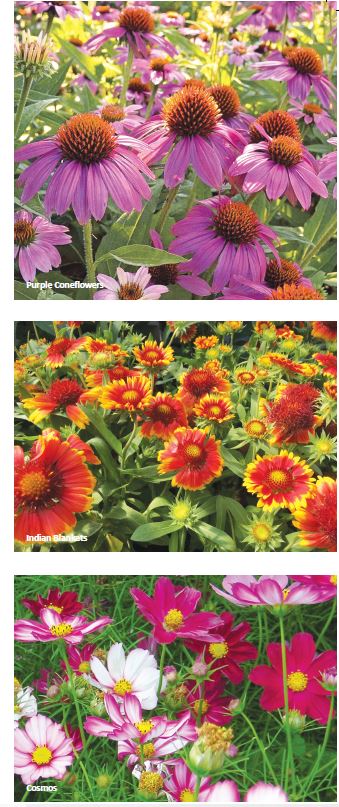
Other wildflowers found in abundance include the Primrose Buttercup (a cup shaped bloom with rose to pale pink flowers and a yellow or white center), the Coneflower (an annual herb with elongated leaves that clasp around the stem at the base and show in a variety of colors), as well as the Cosmos (a great fast-growing plant with brightly colored single or double flowers in white, pink, orange, yellow, or scarlet).
 Not only do we witness the resurgence of all of those beautiful blooms in great quantities, we take great delight in the profusion of other wildflower blossoms. Among them are the thousands of beautiful Brown-eyed Susans (a prairie species found throughout Texas). This is a stiffly upright to sprawling perennial, growing one to three feet with blooms that will last several days when used as a cut flower.
Especially enjoyable is the common sunflower in the fields and pastures of the west end and again in front yards in the east end. Sunflowers grow to a height of ten feet on a stout, upright stalk ending with a huge yellow disk of a bloom.
Also a member of the sunflower family, the Indian Blanket shows itself by the thousands. It is called by the common name “fire wheel” from its appearance of an orange wheel with yellow rays at the tips. This upright annual or perennial herb is native to Texas.
The red-orange flower is a trick-of-the-eye misconception. The bloom of this flower is actually a creamy whitish-yellow, encircled by red-orange leaf-like bracts.
Wild lantanas have naturalized all along the Gulf Coast. Blooming spring through summer and fall, the lantana is a favorite hangout for butterflies.
Lantana's aromatic clusters are a mix of red, orange and yellow. The flowers typically change color as they mature. A favorite is Lantana Camara or more commonly known as “Ham 'n Eggs” due to its pink and yellow inflorescences.
This year, the island has been inundated with a remarkable display of Coreopsis (a plant in the daisy family) in back and front yards, empty lots, and cemeteries triggering comments of appreciation from visitors and residents. This spectacle became a contentious subject among residents when citations were issued stating that the planting of wildflowers required a city permit.
We owe a debt of gratitude to the efforts of Lady Bird Johnson to keep roadside vistas clear and to protect some of the natural beauty of the American landscape. She testified that "surely a civilization that can send a man to the moon can also find ways to maintain a clean and pleasant Earth.”
One of the most eagerly anticipated tours of Galveston Island’s summer season, the “Back-Yard Garden Tour,” presented by Clean Galveston, returned this season after a hiatus of several years. Each year, owners of estate-sized gardens, mini-sized gardens, and gardens tucked along back and side enclosures, open their gates to the public and proudly display the results of endless hours of effort.
This tour has a scope as diversified as the gardeners for whom these oases are a labor of love. There was ample inspiration for us to carry home to our own private grounds.
The tour this year honored the memory of one of Galveston’s most avid gardeners and favorite citizens, Jerry Eubank.