Spring arrived, the gardens were prepared, your favorite tomato varieties were selected, or perhaps you decided to try something new. There are many challenges and rewards to be had in the garden but none as gratifying as strolling through your garden…picking a sample tomato…and eating it on the spot.
Tomatoes are the world’s most popular fruit. More than sixty million tons are produced every year. There are at least 10,000 varieties of tomatoes, from small cherry ones to Ponderosa, which can weigh over three pounds.
An interesting specimen is a tomato that is in a category all its own. Red currants, tiny tomatoes that grow perfectly round in bunches, are bright red and are often called “cute.”
The red currant will produce hundreds of tiny tomatoes (about the size of a blueberry) that boast an overall good taste that is not too sweet. They enhance any dish to which they are added and are great on salads but are best when you pop them into your mouth, one tasty tomato at a time.
Red currants will continue to grow until frost but may continue to produce if the weather is mild. They will need staking or caging for support.
Tomatoes have been showing their colors by this time of year. Have you noticed in other gardens tomatoes in bursts of colors and hues other than the typical red?
They may be heirloom tomatoes. They are eating-tomatoes, pure and simple. An interesting aspect of heirloom tomatoes is their color, a rainbow spectrum including stripes and blushes.
Each one is different; some are meatier, some have fewer seeds, and some taste a bit salty or spicy. Heirlooms can be found in a variety of colors, shapes, flavors, and sizes.
It is hard to believe that such a widely used food source was once considered extremely poisonous. Up until the end of the 18th century, physicians warned against eating tomatoes, fearing they caused not only appendicitis but stomach cancer from tomato skins adhering to the lining of the stomach.
The tomato’s scientific name, Lycopersicon esculentum, translates to edible wolf peach. This name was settled on in 1768 and was named that because a peach was round and luscious, and because wolf was considered poisonous.
The English word tomato comes from the Spanish word tomate. The tomato is native to western South America and Central America.
 In 1519, Cortez discovered tomatoes growing in Montezuma's gardens and took seeds back to Europe where they were planted as ornamental curiosities, but not eaten. Most likely the first variety to reach Europe was yellow in color, since in Spain and Italy they were known as pomi d'oro, meaning yellow apples.
The French referred to the tomato as pommes d'amour, or love apples, as they thought them to have stimulating aphrodisiacal properties.
HYBRID AND HEIRLOOM TOMATOES
Growing tomatoes is likely the most popular of all gardening activities not only among experienced gardeners but with those who putter with a small plot or a container garden, as well. Most of us have our favorite varieties, the ones we plant year after year, again and again. Perhaps it is out of habit or because “my neighbor recommended it” or it was all the nursery had left.
Currently, the tomatoes most commonly preferred fall into two categories, the hybrid and the heirloom. Since there are thousands of varieties of tomatoes available for the home vegetable gardener today, there may be some confusion between what is a hybrid and what is an heirloom tomato.
Hybrid tomato varieties are produced by plant breeders that have selected two compatible tomato varieties and cross bred them to create a new tomato variety that features traits from the two parent plants.
For instance, a breeder may select a specific tomato plant because of its resistance to blight and diseases and then another that produces in a short length of time. The new tomato will have an early production rate and be blight- and disease-resistant, as well.
The definition of the use of the word heirloom to describe plants is highly debated. One school of thought places an age or date point on the cultivars. For instance, some say that the seeds must be over 100 years old while others say 50 years.
Another way to describe heirloom cultivars is to use the definition of the word "heirloom" in its truest sense. Under this interpretation, a true heirloom is a cultivar that has been nurtured, selected, and handed down from one family member to another for many generations.
Additionally, there is another category of cultivars that could be classified as "commercial heirlooms." These include cultivars that were introduced many generations ago and were of such merit that they have been saved, maintained and handed down, even if the seed company has gone out of business or otherwise dropped the line.
POPULAR HYBRIDS
Better Boy
Better Boy holds a Guinness Book of World Records for yields- nearly 350 pounds of tomatoes from a single plant over a single season! Superior disease resistance, unbeatable flavor, and wide adaptation to climates and conditions all make this beefsteak the undisputed champ. They are succulent, juicy, yet meaty tomatoes averaging about a pound apiece.
 Early Girl
Early Girl has been a favorite for decades. These fruits are meaty, aromatic, and flavorful. You simply can't find a better slicing tomato than Early Girl. These four to six-ounce fruits are ready in just under two months, red-skinned, smooth, and delectable. They are filled with tasty juice, and have an old-fashioned, rich tomato tang that imparts more flavor than many modern varieties can.
Celebrity
An All-America Selection (AAS) winner and long-time popular favorite of American gardeners, Celebrity is a superior all-around tomato with fantastic disease resistance. These plants are exceptionally strong, bearing masses of smooth, round, bright red tomatoes. Weighing about eight ounces, these "vine ripened" tomatoes are very uniform (no green shoulders here) and resistant to cracking. Yields about twenty to the stem on plants that will definitely need staking or caging to hold their huge bounty.
POPULAR HEIRLOOMS
Calabash This tomato is a flattened ribbed, dark purple medium-to-large fruit that grows on prolific vines. It is uniquely acidic, but with a rich and concentrated somewhat sweet flavor. Delicious fresh, this tomato really shines in sauces and pastes.
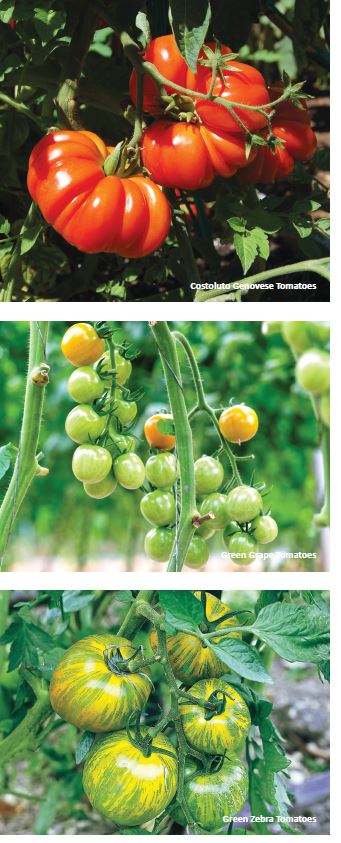
Costoluto Genovese
These red colored tomatoes are rich, meaty Italian heirloom fruits adapted to hot weather. Since these plants are open-pollinated, seeds from the plants can be saved each year and grown for generations. Their robust flavor is perfect for use on sandwiches and for fresh eating.
Garden Peach
This unique heirloom has a peach-like fuzz and is yellow, often with a hint of pink blush when fully ripe. They have a delicate, distinctive flavor that's light, clean and a little bit fruit-like. They are small, usually only 2 oz. in size.
Green Grape
These are a favorite heirloom variety of farmers markets and restaurants because of their unique tangy-sweet flavor and attractive green appearance, and many find the small grape-like fruits addictive. The quarter-size fruit will grow in a cluster of about six to eight. They are easy to grow.
Green Zebra
This attractive variety has beautiful bright chartreuse coloring with deep lime-green stripes. Small to medium at around 3 ounces, they are very rich tasting and sweet with a sharp bite to it. A favorite gourmet quality tomato of many high-class chefs, specialty markets, and home gardeners. Yield is excellent.
Persimmon
This variety produces large fruit at 12-16 ounces and its rich flesh is the same lively rose-orange color of the skin. Because this tomato's seed cavities are very small it has a higher concentration of solid flesh than many other varieties. It has a marvelous flavor that is highly rated in taste tests—low in acidity, creamy, and fruity.